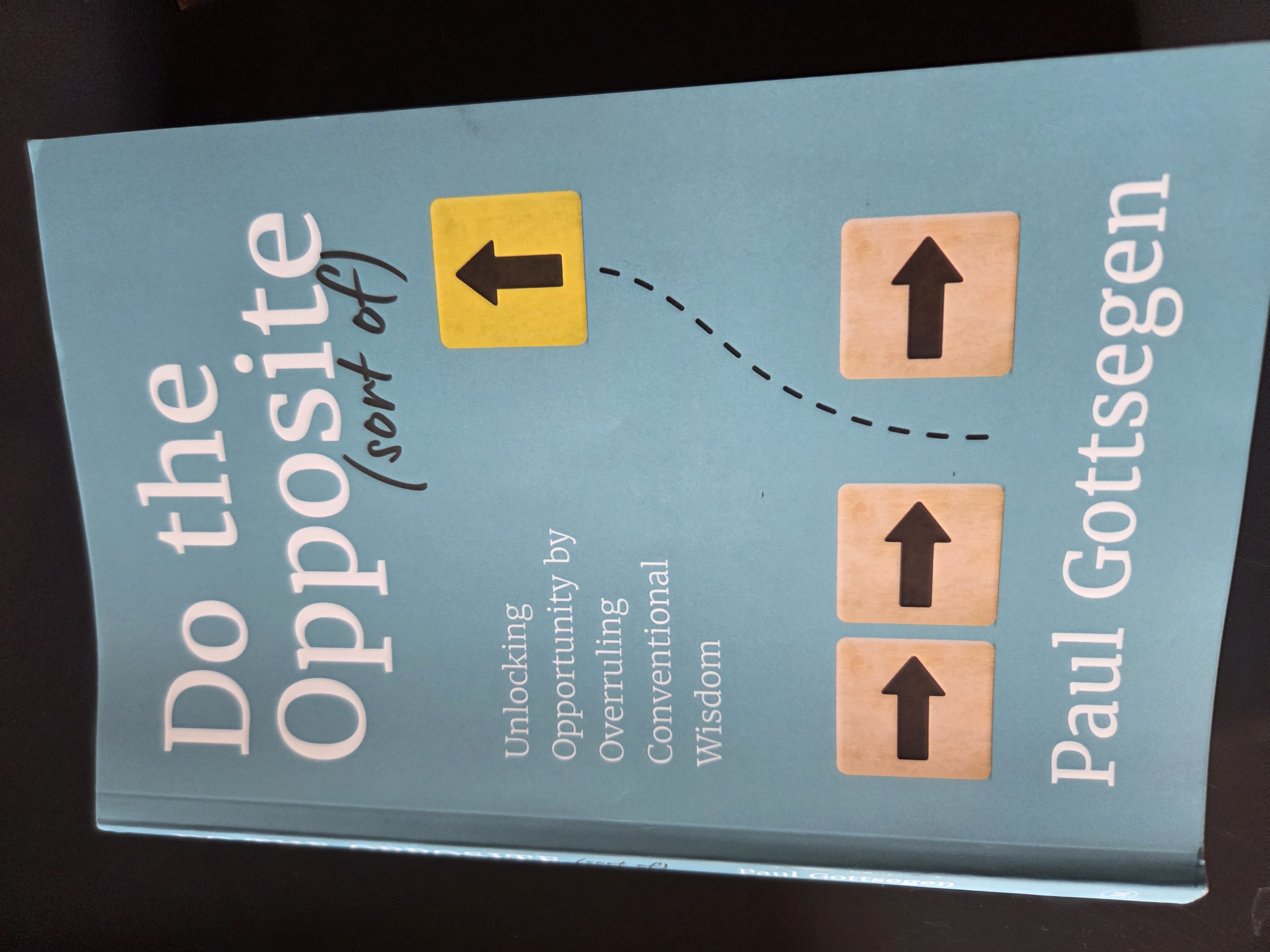
Book Review: Do the Opposite (sort of) by Paul Gottsegen
Feb 11, 2026
Per the author's advice, here’s my summary for all you busy leaders:
- A well-written, easy read that balances advice, how-to, and strategic leadership.
- It’s definitely worth the read.
- You may even unlock your own unconventional approaches to opportunity, wisdom, and success for you and your team.
I don’t know Paul, but I’m a fan of his writing on LinkedIn. However, my husband is a colleague of his, so when a personally inscribed copy of Do the Opposite (sort of) Unlocking Opportunity by Overruling Conventional Wisdom by Paul Gottsegen showed up in the mail, I squealed, “Ooh, I want to read that!”
Bucking convention to get better leadership results? Sounds perfect. Count me in!
And because my husband is a nice guy, he handed it over so that I could read it first.
Paul is a talented and successful IT and Marketing leader with decades of experience in some excellent firms. Given his style of writing on LinkedIn, which I deeply enjoy when the algorithm will serve it up to me, I suspected this book would be an entertaining read.
And it is. Paul’s a relatable storyteller, just see his reminiscence about key note speaking at VMware back in the day. Even if you don’t know understand the technology referenced, you totally get the connection he created with his carefully prepared story.
Heck, even the back cover makes you want to stand up and cheer with him as he rallies you with encouraging statements like, “Modern business leaders need to be more authentic and kinder. Can you do this and still be a powerful and successful business leader? Yes!”
Nevertheless, due to his tenure and success, I expected a book that shared some lofty and perhaps untenable ideals about leadership. It feels like many executive-authored books trend that way these days: good intentions, difficult to execute.
Instead, what caught me off guard was the practicality of the book. It feels like part handbook, part cookbook for leading teams. And since we know it’s not THAT easy to lead, this book shows Paul’s ability to distill information in a way that is approachable and mostly reasonable.
The book doesn’t delve too far into the intricacies of executive level leadership. We get some awesome stories about interactions with CEOs and boards, but the intimate look at the daily challenges and pressure of the high-level roles are mostly boiled down to “big revenue targets” and stressful “challenges” and then set to the side as if we surely understand the rigors of the role. But I'd like to hear more about how complicated it was to accomplish so much. I’d like to understand more about the detailed rigors. Maybe that’s coming in book 2.
In the meantime, this book provides some rather handy lessons that we can apply at almost any level of management and leadership.
He starts off explaining the thing that trips up so very many of us. It’s easy to relate to and it is why Boss at the Helm exists today: to help managers and leaders recognize and drop their unintentional habits and lean into authentic and intentional leadership.
When Paul was first promoted to people manager he said, “…I copied my boss’s manner. It was the only style I had experienced. I just assumed this is how all great managers lead teams.”
And then you get to hear about the resulting crash and burn.
It's familiar to so many of us as we either bemoan the bad bosses we’ve had or regret the choices we’ve made in our journey through leadership (or both).
Ideas I love:
- Hand the team their power – you follow their orders not vice versa.
- Be an evangelist of the business – no matter the level and role you play.
- Treat every skip-level interaction like the golden opportunity it is and distinguish yourself.
- Now what I particularly love here is that Paul doesn’t advise telling stories or detailing something unicorn-ish about yourself; instead, he says to prepare, anticipate, and make sure you don’t rely only on day-to-day knowledge to get you through.
The list of practical advice goes further, speaking to PowerPoints, introductions, public speaking and even LinkedIn usage.
He gives some excellent advice on accountability, in particular “Don’t do it because I said so.” This is powerful learning in that it is a lesson not only for the leader but also for the individuals on the team.
There is nearly step-by-step advice for decision making. Frankly, I’d love to see this expanded into a full-fledged course & treated as required material in most companies.
One of my favorite parts of the book (it made me laugh out loud and stop to think) was the section on how we show up to meetings, especially virtual video meetings.
Before I go there, I’ll also share there are other parts of the book that amuse me greatly because they remind me of that cranky person yelling, “You kids stay off my lawn!” The book is full of well-intentioned advice showing you that the details really matter to Paul. And, lest you think I’m only poking fun, notice again how ridiculously successful and pleasant this guy is. You cannot shake your head at these because they clearly worked, over and over and over, even if they might feel like obsessive precision:
- Don’t start a meeting early, but don’t wait for people either. Start exactly on time.
- Don’t use your out of office feature if you’re not on holiday.
- NUA: never use acronyms (initialisms).
- No orphans! Carefully craft all bulleted lists, just figure it out, to avoid a word
wrapping - And, for the love of all people’s sanity, turn off those Excel gridlines.
Okay, joking aside, let’s go back to the analogy I most loved. It’s probably so near and dear to me because I feel like I spend way too much of my own time shaking my hand and yelling to stay off the lawn over this particular topic.
If you’re on a video call – be on video. Show up, dang it.
I’ve seen so many people, from front line, entry-level, heck even an interviewee, all the way to SVPs, join a meeting and keep their video off. They don’t even have a smiling photo placeholder. Nope, just that awful black square. And that’s the brilliant analogy that Paul makes.
He writes, “You wouldn’t attend a meeting in person and then put a black sheet over your entire self. That would be silly. Yet, it is happening every day when people are not on video in a meeting.”
For more of this and other unconventional wisdom, I encourage you to check out Do the Opposite (sort of).
Stay connected with news and updates!
Join our mailing list to receive the latest news and updates from our team.
Don't worry, your information will not be shared.
We hate SPAM. We will never sell your information, for any reason.
