6 Ways to Find Your Blind Spots So You Can Make Better Judgment Calls
Oct 05, 2026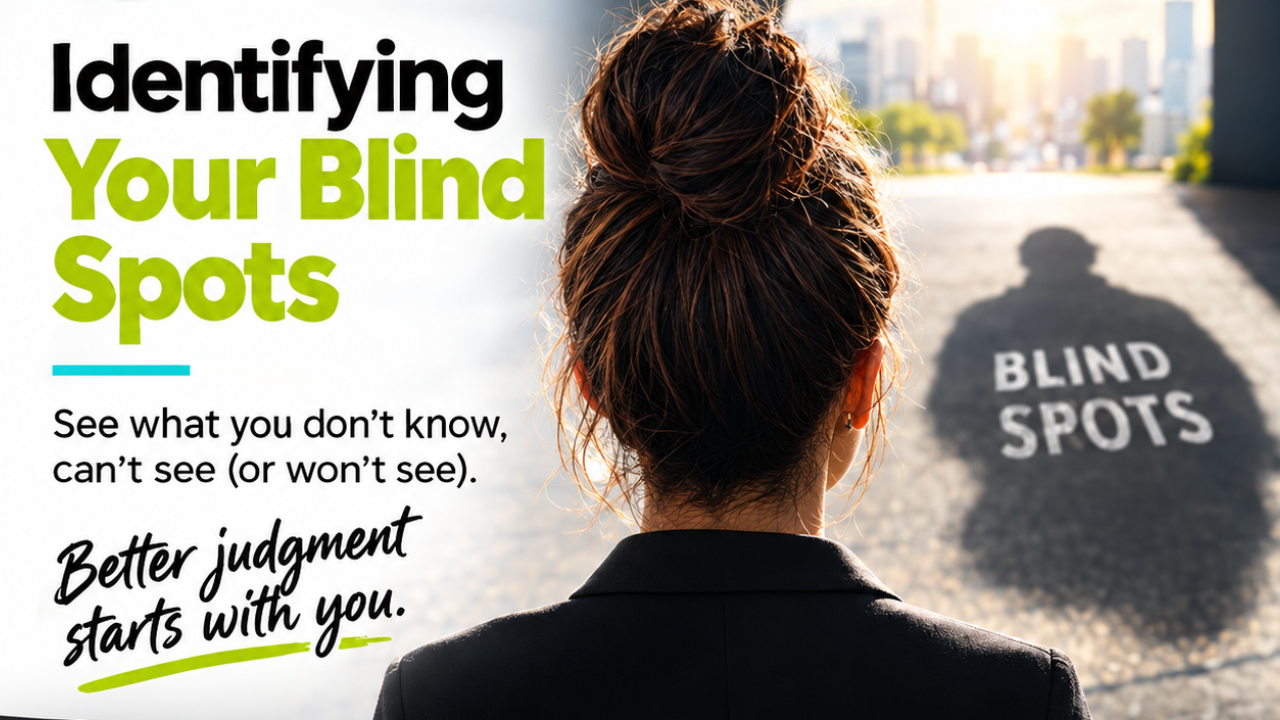
"How can I figure out my own blind spots? That seems like trying to find something in the dark. If I knew what they were, I wouldn't be blind to them!"
A leader asked me that after I had just taught a roomful of conference attendees The Sign-Off℠, a 30-second tool for better judgment that we built at Boss at the Helm.
It's a great question, and one most of us struggle with.
Most people there, me included, were focused on AI. I made the case for building our discernment, judgment and decision-making skills, because that's where I think we were already behind. It's also become even more important since AI put recommendations and confident decisions in everyone's hand, at speed and volume.
We need to be able to make good judgment calls & decisions now more than ever. But since most of us aren't good at it, we also need a tool to help.
Why Blind Spots?
Judgment, discernment, and ethical decision-making are Human Intelligence skills. Machines won't master them, and we rarely teach them. AI raised the stakes. More decisions, made faster, by more people.
To build those skills, you've got to practice. And sometimes we need a simple way to pause and keep ourselves from operating on auto-pilot, making the same old decisions, judging situations as if they haven't evolved, or blindly accepting the confident answer put in front of us whether it comes from an 'expert' or a tool.
The Sign-Off℠ asks three questions about blind spots, stakes, and signature. Blind spots come first, and they're the hardest, because you're hunting for what you don't know yet or maybe for what you're refusing to admit.
The best way to get better at identifying your blind spots is though self-awareness. Blind spots tend to hide right next to what you repeat, resist, defend, or avoid. Notice those.
Six Ways to Find Your Blind Spots
- Reframe the decision. How would someone you respect look at this? What would they ask you? What would have to be true for you to get this right, or wrong?
- Run a pre-mortem. Credit to psychologist Gary Klein. Jump six or 12 months ahead and imagine the decision failed. Write out what went wrong, what data you missed, and who you left out. Or flip it: Imagine it worked out and describe how you got there.
- Check your motivation. Are you eager to push this through? Defensive? Avoiding the call? Revisit feedback you pushed aside. Check your confidence, too. Adam Grant's Think Again makes the case that the most confident people are often the least aware of what they don't know. If you feel sure, can you defend it?
4. Don't box yourself in. Wisdom lives outside your work team, your family, and your friend group. Ask others for their perspective, experiences, and insights. Their answer may not decide it for you, but it adds to the context you consider.
- Ask AI to argue with you. AI will flatter you, and it says wrong things with confidence. Don't pre-load it to agree. Ask it to take the opposing view and point out your flaws and gaps. Try more than one tool, in separate chats.
- Question your POV & data. What do you know for sure? Where did the data come from, how new is it, and whose point of view is missing?
How to Practice Better Judgment This Week
Judgment is a muscle, and you build it with reps. Pick one:
- Run one live decision through The Sign-Off℠, and spend extra time on blind spots.
- Review your last three to five decisions. Bonus points if you ask someone who was involved for their feedback on how you handle the situations.
- Start a decision log. Write down the scenario and your Sign-Off℠ answers, and your predicted outcome. Come back later and record what happened. Annie Duke's Thinking in Bets reminds us that good decisions can have bad outcomes, and bad decisions can get lucky. Track your process, your prediction, and your outcome.
Watch this week's Mini but Mighty℠ Leadership Lesson on YouTube: You Don't Know What You Don't Know. How Leaders Find Their Blind Spots. We post a new lesson every week, so subscribe and you won't miss one.
Lead yourself. Then lead others. Be a Boss.
________________________________________
Building judgment across your organization? The Helm Leadership Essentials℠ Cohort gives your leaders practice, feedback, and shared language to make better calls with humans and with AI. Reach out at bossatthehelm.com/contact.
Stay connected with news and updates!
Join our mailing list to receive the latest news and updates from our team.
Don't worry, your information will not be shared.
We hate SPAM. We will never sell your information, for any reason.
